How to efficiently machine shaped parts on CNC mill-turn machines?
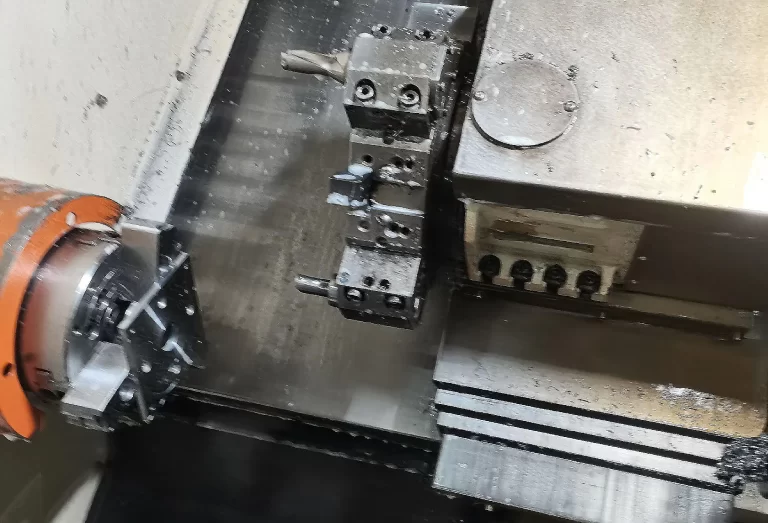


Positioning and clamping are fundamental to achieving accuracy, stability, and efficiency in machining operations.
Proper locator selection and clamping design directly influence workpiece positioning accuracy, deformation control, and overall machining quality.
This article systematically explains the core principles of side-surface and hole-based positioning, introduces common clamping methods and their characteristics, and highlights practical considerations such as load direction, operability, and pre-clamping.
Together, these concepts provide a solid foundation for designing reliable fixtures and improving machining consistency.
Locators define the workpiece position by constraining its degrees of freedom and establishing accurate reference datums. Proper locator selection prevents over-constraint, reduces deformation, and ensures repeatable positioning.
Common locator strategies are based on side surfaces or pre-machined holes, with side-surface locating being the most widely used.
When locating from the side surface of a workpiece, the three-point principle serves as the fundamental guideline, analogous to support devices.
This principle, termed the three-point rule, originates from the concept that three non-collinear points can define a plane.
Three points out of four can define a plane, meaning four planes can be determined in total.
However, regardless of the positioning method, it is quite difficult to ensure the fourth point lies within the same plane.
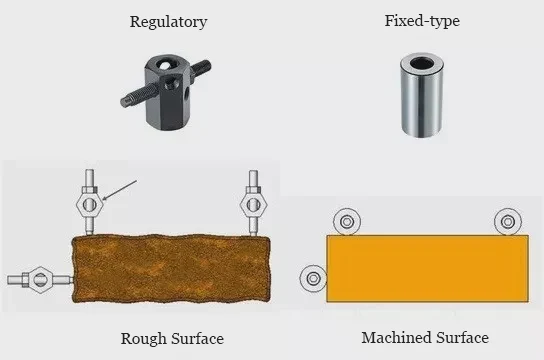
For example, when using four locators at fixed heights, only three points at specific locations can contact the workpiece.
The remaining fourth point has a high probability of not making contact with the workpiece.
Therefore, when configuring locators, the standard practice is to base the setup on three points and maximize the distance between these three points.
Additionally, when configuring locators, the direction of applied machining loads must be confirmed beforehand.
The direction of the machining load corresponds to the feed direction of the tool holder/cutting tool.
Positioning locators at the end of the feed path directly impacts overall workpiece accuracy.
Generally, when locating on the workpiece’s rough surface, use bolt-type adjustable locators; when finding on the machined surface, use fixed-type locators (with ground contact surfaces).
When utilizing holes machined during preceding processes for positioning, toleranced pins must be employed.
By combining the precision of the workpiece hole with the precision of the pin’s external form according to the fit tolerance, the positioning accuracy can meet practical requirements.
Additionally, when employing pins for positioning, it is common practice to use a straight cylindrical pin for one assembly and a diamond-shaped pin for another.
This approach facilitates easier assembly and disassembly of the workpiece, significantly reducing the likelihood of binding between the workpiece and pins.
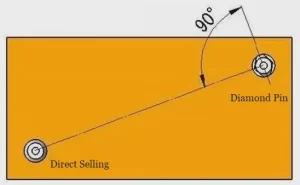
Of course, it is also possible to use straight pins for both pins by adjusting the fit tolerances.
For more precise positioning, using one straight pin and one diamond-shaped pin is typically the most effective approach.
When using one straight pin and one diamond pin, the configuration typically positions the diamond pin’s contact surface perpendicular (at 90°) to the line connecting the straight pin and diamond pin.
This arrangement facilitates angular positioning (relative to the workpiece’s rotational direction).
Clamps apply force to hold the workpiece against locators and resist cutting forces during machining.
Proper clamping must ensure stability without causing deformation or shifting of the workpiece. Clamping devices are commonly classified based on the direction of applied force.
Based on clamping direction, they are generally categorized as follows:
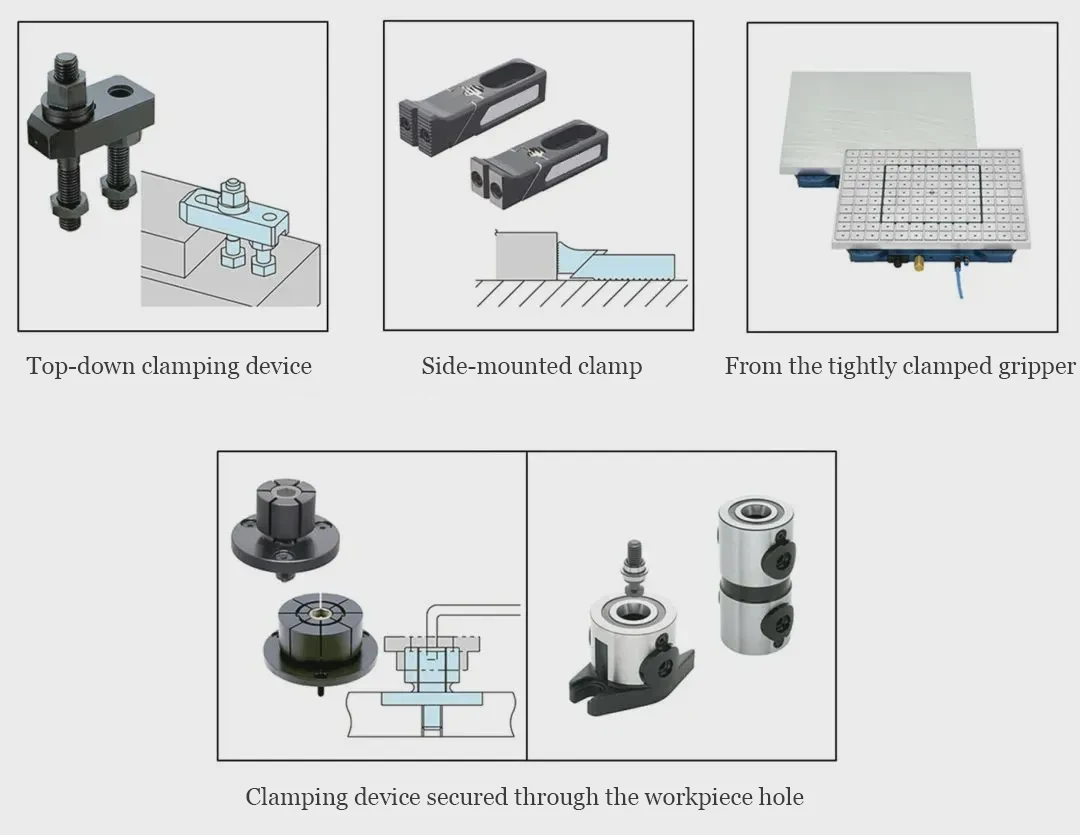
Next, let’s examine the characteristics of various clamping devices.
Clamping devices that apply pressure from above the workpiece exhibit minimal deformation during clamping and provide the most stable processing conditions.
Therefore, top-down clamping is typically the first approach considered under normal circumstances.
The most common type of top-clamping fixture is the manual mechanical clamp.
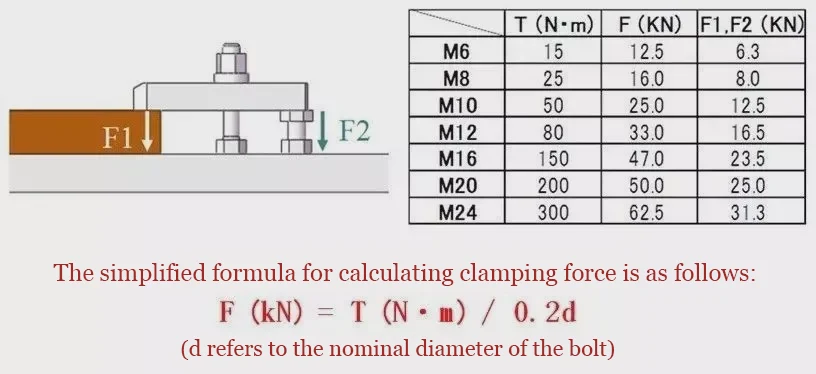
For example, the clamp shown below is called a “pine needle clamp.”
This clamp, composed of a clamping plate, double-headed bolts, a jack, and nuts, is referred to as a “pine needle clamp.”
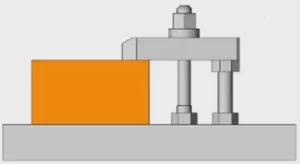
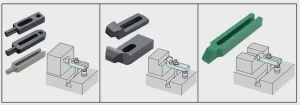
Additionally, different-shaped clamping plates can be selected to accommodate various workpiece shapes based on their specific contours.
The relationship between torque and clamping force during the clamping operation of a pine-leaf clamp can be calculated using the bolt’s thrust force.
Clamping devices that secure workpieces from above include the following types in addition to the leaf clamp.
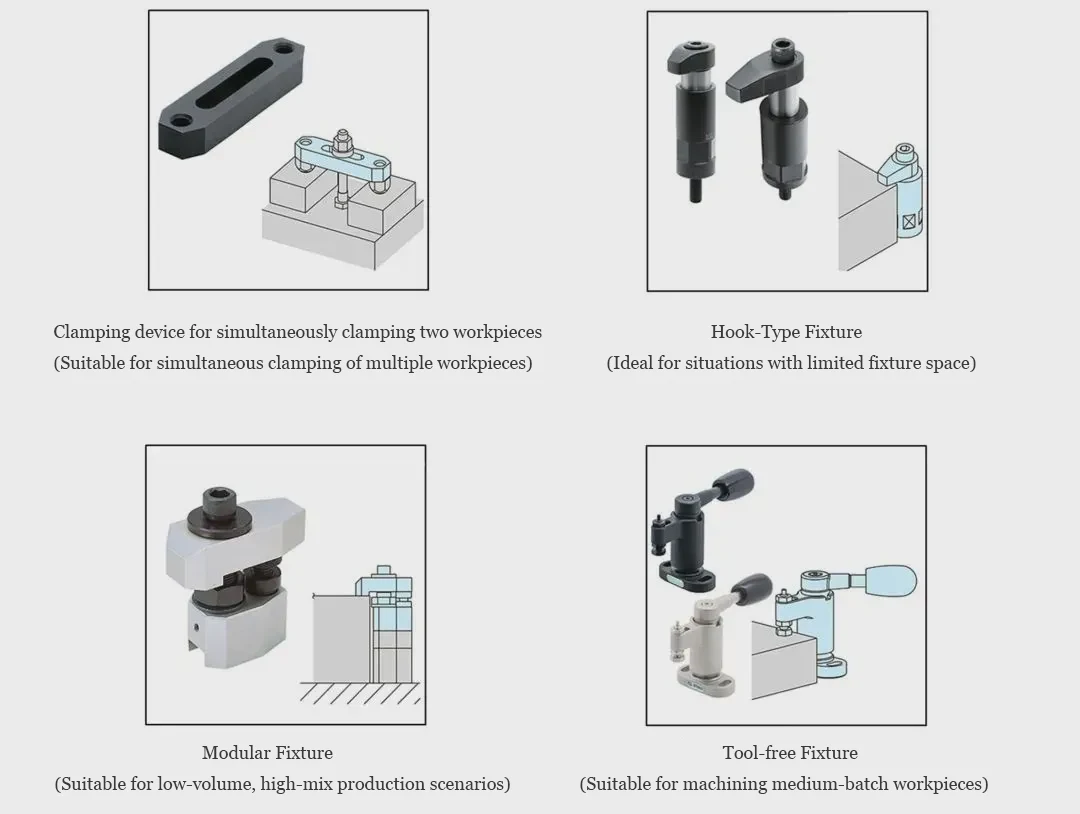
Traditionally, clamping workpieces from above offers the most stable precision and imposes the least processing load on the workpiece.
However, when clamping from above is impractical—such as when the top surface requires machining or when overhead clamping is unsuitable—side clamping becomes a viable alternative.
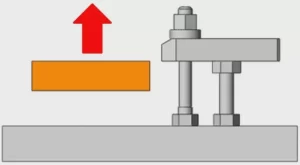
However, clamping from the side generates an upward buoyant force on the workpiece.
Eliminating this force is a critical consideration during fixture design.

Clamping devices that apply force from the side, as shown in the figure above, generate thrust laterally while also exerting a downward force.
This type of fixture effectively prevents the workpiece from floating upward.
Clamping devices that apply force from the side also include the following similar types.
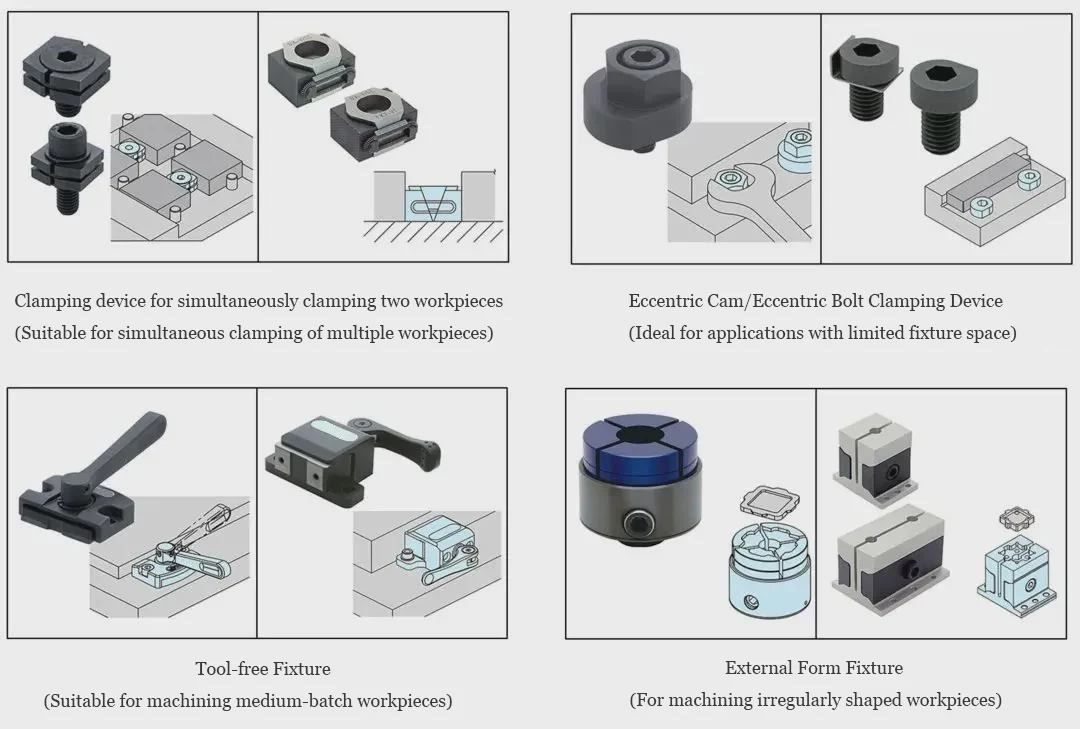
When machining the upper surface of thin-plate workpieces, clamping from above is not only impractical, but side clamping is also unreasonable.
The only viable clamping method is pulling the workpiece from below.
For iron workpieces clamped from below, magnetic clamping devices are typically used.
For non-ferrous metal workpieces, vacuum suction cups are generally employed for pulling.
In both scenarios, the magnitude of the clamping force is directly proportional to the contact area between the workpiece and the magnet or vacuum suction cup.
If the machining load becomes excessive during processing of small workpieces, the machining results may be less than ideal.
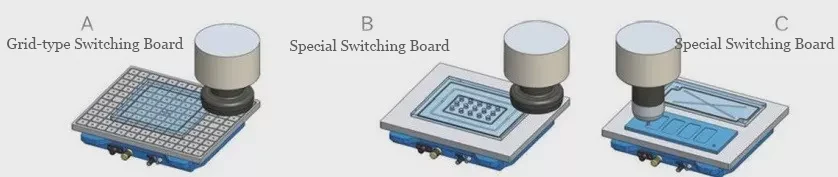
Additionally, when using magnets or vacuum cups, the contact surface must be polished to a certain smoothness to ensure safe and proper operation.
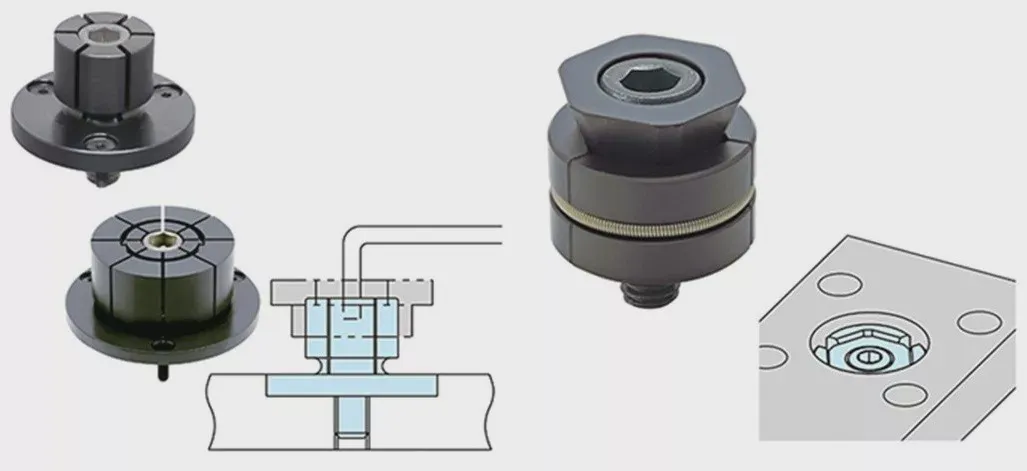
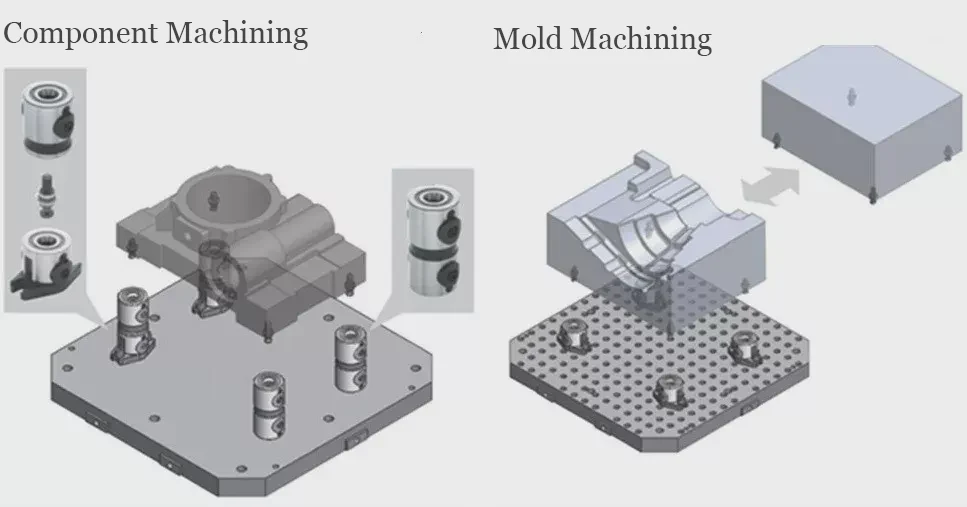
When performing multi-surface simultaneous machining or mold machining with a 5-axis machining center, bore clamping is generally the preferred method to prevent fixtures and tools from interfering with the machining process.
Compared to clamping from above or the side, bore clamping imposes less stress on the workpiece, effectively minimizing deformation.
The above primarily discusses fixtures for workpiece clamping. Enhancing operability is crucial, and pre-clamping plays a vital role in achieving this.
When positioning a workpiece vertically on the base, gravity causes it to fall downward.
In such cases, the operator must manually hold the workpiece in place while operating the clamping device.
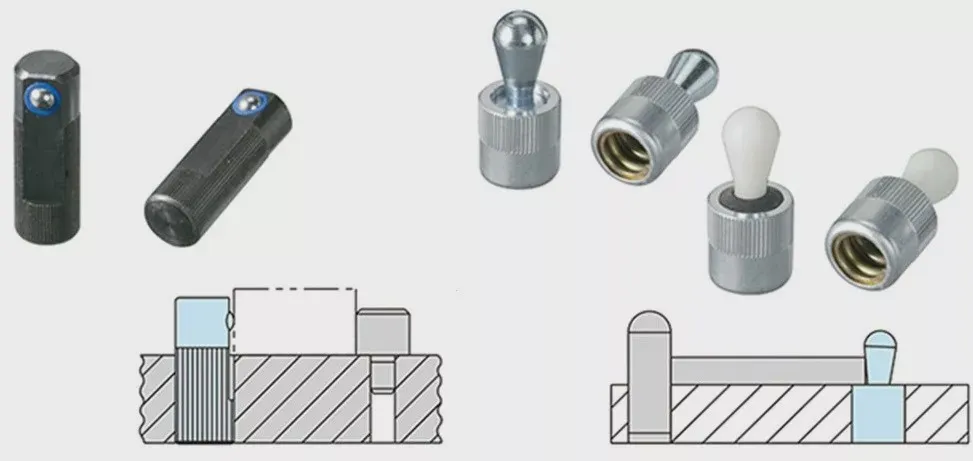
When workpieces are heavy or multiple pieces are clamped simultaneously, operability significantly decreases and clamping time increases considerably.
In such cases, using spring-loaded pre-clamping products allows the clamping device to be operated while the workpiece remains stationary, greatly improving operability and reducing workpiece clamping time.
When using multiple types of clamping devices within the same fixture, ensure that the tools used for clamping and releasing are standardized.
For example, in the left diagram below, employing various tool wrenches for clamping operations increases the operator’s overall workload and prolongs the total clamping time for the workpiece.
Conversely, as shown in the right diagram below, standardizing both the tool wrenches and bolt sizes facilitates on-site operation for personnel.
Additionally, when configuring clamping devices, it is essential to prioritize the operability of workpiece clamping as much as possible.
If the workpiece requires tilted clamping during installation, this significantly compromises operability.
Such scenarios should be avoided during the design of fixtures and tooling.
Effective positioning and clamping are not merely setup tasks but critical determinants of machining success.
By applying principles such as the three-point locating rule, pin positioning, and selecting appropriate clamping methods—whether top-down, side, bottom-pull, or bore clamping—machinists can minimize deformation, enhance stability, and improve operational efficiency.
Incorporating pre-clamping and standardized tooling further optimizes usability and reduces setup time.
A well-designed positioning and clamping strategy ultimately ensures higher precision, better repeatability, and safer, more efficient machining processes.